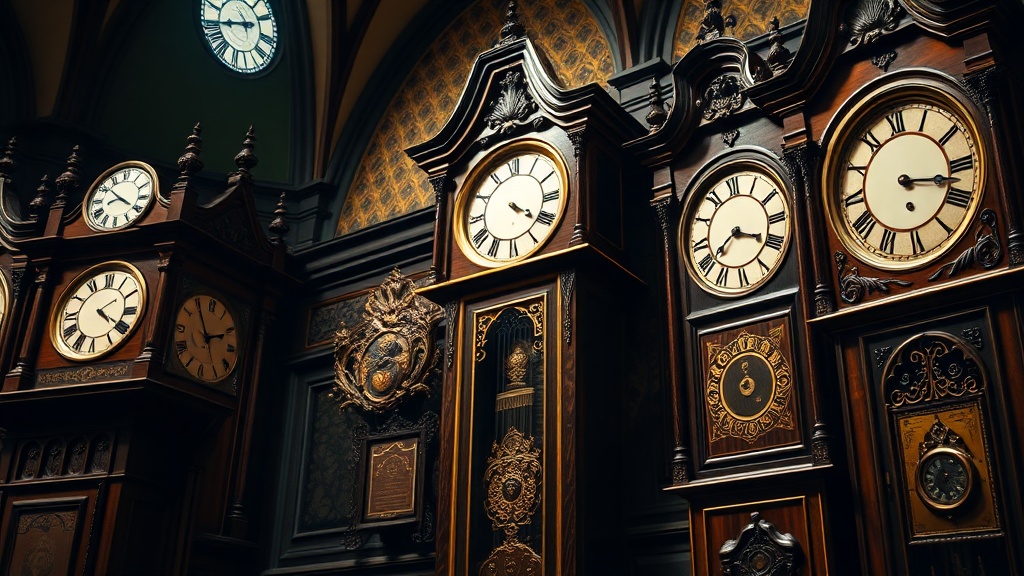
The Fascinating History of Grandfather Clocks: From 17th Century Origins

Grandfather clocks represent one of the most enduring symbols of craftsmanship in the collecting world. This post traces their evolution from 17th-century England through the golden age of American clockmaking — and explains what separates a museum-quality piece from a mass-produced reproduction. Whether you're hunting for your first longcase clock at a San Diego estate sale or trying to date a family heirloom, you'll find the specific markers that determine value, authenticity, and historical significance.
When Was the First Grandfather Clock Invented?
The first grandfather clock — though it wasn't called that yet — appeared in 1656. Dutch mathematician and physicist Christiaan Huygens invented the pendulum regulator that year, revolutionizing timekeeping accuracy from minutes per day to seconds per week. English clockmaker William Clement applied this technology to tall case clocks shortly after, creating the foundational design that would dominate horology for centuries.
The name "grandfather clock" didn't exist until much later. Henry Clay Work composed the song "My Grandfather's Clock" in 1876 — inspired by a longcase clock at the George Hotel in Piercebridge, England that stopped working the moment its owner died. The catchy tune stuck, and the nickname eventually replaced "longcase clock" and "floor clock" in popular usage.
Early English examples from the late 1600s featured 8-day movements (wound weekly), brass dials, and cases reaching 6 to 7 feet tall. These weren't decorative furniture — they were precision instruments housed in wooden cases to protect the pendulum from dust and air currents. The weight-driven mechanism used a pair of cast-iron weights suspended by ropes or chains, with an anchor escapement controlling the pendulum's swing.
London emerged as the center of quality production. Makers like Thomas Tompion, Joseph Knibb, and Daniel Quare established standards that collectors still reference today. A genuine Tompion from the 1690s can fetch six figures at auction, though most working antique grandfather clocks from reputable makers fall in the $3,000–$15,000 range depending on condition and provenance.
How Can You Tell If a Grandfather Clock Is an Authentic Antique?
Authentic grandfather clocks display specific construction methods, materials, and wear patterns that reproductions struggle to replicate convincingly. The dial provides the first clue — brass dials predominated before 1770, painted metal dials became common between 1770–1820, and painted wood dials appeared in American clocks after 1800. Look for hand-engraved chapter rings, genuine silvering (not chrome plating), and period-correct numerals.
The movement tells an even clearer story. Authentic antique movements feature:
- Hand-finished brass plates with filed edges, not stamped or laser-cut
- Count wheel or rack striking mechanisms appropriate to the period
- Genuine hand-hammered brass gears with visible tool marks
- Original escapements — verge before 1720, anchor after
- Period-appropriate fasteners — hand-filed screws, not modern machine threads
Case construction offers additional verification. English oak and walnut dominated before 1730; mahogany took over as the premium choice through the Georgian period. American makers favored cherry, maple, and pine (often painted to simulate mahogany). Dovetails should be hand-cut and slightly irregular — perfectly uniform spacing suggests machine production from the 20th century.
The catch? Many "antique" grandfather clocks on the market are actually marriage pieces — cases and movements that didn't start life together. A 1720s movement crammed into an 1820s case destroys collectible value, even if both components are genuine antiques. Always verify that the dial aperture matches the movement's winding holes and that the seat board shows appropriate wear patterns.
For serious authentication, consult the National Association of Watch and Clock Collectors or engage a specialist horologist. Regional clockmaker directories — like Brian Loomes's reference works on English makers — help verify signatures and working dates.
What Are the Most Collectible Grandfather Clock Brands and Styles?
Certain makers and styles command premium prices in today's market. English longcase clocks from renowned London makers top the hierarchy — Tompion, Mudge, Graham, and Ellicott regularly achieve strong results at Sotheby's clock auctions. Scottish and provincial English makers offer better entry points for new collectors, with quality pieces available starting around $2,500.
American grandfather clocks split into distinct regional schools:
| Region/Period | Key Characteristics | Notable Makers | Typical Value Range |
|---|---|---|---|
| Philadelphia (1730–1790) | Tall cases, elaborate bonnets, brass dials with silvered chapter rings | Peter Stretch, Benjamin Chandlee | $15,000–$100,000+ |
| Boston (1750–1800) | Conservative styling, block-and-shell feet, japanned cases | Gawen Brown, Aaron Willard Sr. | $8,000–$75,000 |
| Connecticut (1800–1840) | Pillar-and-scroll cases, painted wood dials, 30-hour movements | Seth Thomas, Silas Hoadley, Eli Terry | $1,500–$12,000 |
| Pennsylvania German (1760–1820) | Decorative folk art, floral painted dials, walnut cases | Various anonymous craftsmen | $3,000–$25,000 |
The Pennsylvania German style — particularly pieces from Lehigh and Berks counties — has gained significant collector attention recently. These clocks often feature original iron dial paintings depicting landscapes, ships, or patriotic symbols. Unlike the formal English-inspired pieces from Philadelphia, these reflect genuine folk art traditions with quirky proportions and bold decorative choices.
Worth noting: the "golden age" of American clockmaking (roughly 1780–1820) produced exceptional quality at relatively affordable prices compared to English contemporaries. A working Aaron Willard clock from 1795 might cost $12,000–$20,000 — the equivalent English piece could command triple that amount. For collectors focused on craftsmanship rather than national origin, American pieces offer compelling value.
Movement Types and Their Significance
Grandfather clock movements evolved through distinct technological phases. The 30-hour movement (requiring daily winding) dominated early production and remained common in budget-conscious American clocks through the 1840s. These are simpler mechanisms with single weights — perfectly serviceable, but less desirable to collectors than 8-day movements.
The 8-day movement became standard for quality English clocks by 1690 and American pieces by 1760. Two weights drive separate functions — one for timekeeping, one for striking. Quarter-hour chimes appeared in high-end English clocks from 1720 onward, with the Westminster chime (introduced by Edward quarter in 1793) becoming the dominant pattern.
Here's the thing about chimes: original musical movements command massive premiums. A genuine three-train clock (time, hour strike, quarter chime) from a notable maker represents the pinnacle of mechanical complexity. Reproduction chime mechanisms added to antique cases — unfortunately common — actually reduce value despite adding functionality.
How Should You Maintain and Display a Vintage Grandfather Clock?
Proper maintenance determines whether an antique clock survives another generation or slowly destroys itself. Environmental stability matters most — temperature swings cause wood cases to expand and contract, loosening joints and cracking veneers. Ideal conditions stay between 65–72°F with relative humidity at 45–55%. That sunny spot by the window? It's slowly cooking your clock.
Level placement isn't optional. Grandfather clocks rely on gravity — an out-of-level case throws off the pendulum's swing, causing irregular timekeeping and uneven wear to the escapement. Use a quality spirit level (the Stabila 196-2 series works well) on both the case base and the seat board where the movement rests.
Winding follows specific protocols. For chain-driven movements, pull the free end straight down — never lift the weight by the chain itself. Rope-driven clocks require gentler handling; original hemp ropes from the 18th century still exist in some pieces and demand careful treatment. If the clock hasn't run in years, resist the urge to "test" it yourself — gummed oil and accumulated dirt can damage pivots when forced into motion.
Professional servicing intervals depend on use. Running clocks need cleaning and re-oiling every 5–7 years. Dormant clocks should still be inspected every decade — old oil polymerizes into abrasive varnish that etches steel pivots. Expect to pay $300–$800 for a proper overhaul from a qualified horologist. The investment preserves functionality and prevents catastrophic (expensive) damage.
That said, not every clock needs to run. Many collectors prefer static display to preserve original components — particularly for rare or fragile pieces. A non-running antique grandfather clock in original condition often holds more value than a "restored" example with replaced parts and refinished surfaces. The patina of age, when genuine, tells a story that no reproduction can match.
"Buy the seller before you buy the clock." — Old horological saying
The San Diego area offers surprisingly good hunting grounds for antique clocks — estate sales in Rancho Santa Fe and La Jolla regularly surface East Coast imports brought west by wealthy transplants. Local auction houses like Bonhams San Francisco (which holds periodic Los Angeles sales) occasionally feature significant longcase pieces. For daily browsing, the antique malls along Adams Avenue and Kettner Boulevard yield more modest finds — though condition varies wildly.
Online marketplaces require extreme caution. eBay's authenticated program offers some protection for high-value purchases, but most grandfather clocks sell through specialized dealers who provide condition reports and provenance documentation. The International Society of Appraisers maintains a directory of qualified specialists who can evaluate pieces before purchase — well worth the $200–$400 fee for clocks priced above $5,000.
The enduring appeal of grandfather clocks lies in their mechanical honesty. No batteries, no circuit boards, no planned obsolescence — just brass, steel, wood, and gravity working in precise harmony. For collectors willing to learn their language of ticks and tocks, these towering timekeepers offer a tangible connection to centuries of craft tradition.