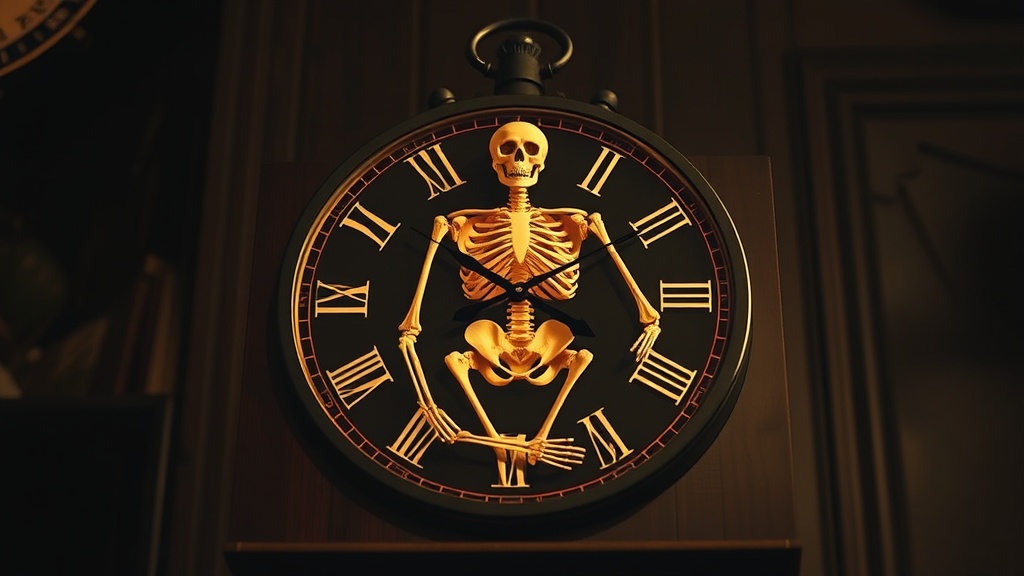
The Evolution of the Skeleton Clock

Imagine a 19th-century workshop where a master clockmaker strips away the heavy-looking brass plates and the opaque porcelain dials common in that era. What remains is a skeletal structure of gears, levers, and escapements—a machine that doesn't just tell time, but displays the very mechanics of time itself. This post explores the technical evolution of the skeleton clock, from its origins as a display of virtuosity to its status as a highly sought-after collector's item. We'll look at the engineering shifts that allowed these movements to become visible and the specific characteristics that define high-quality pieces today.
What Defines a True Skeleton Clock?
A true skeleton clock is a timepiece where the dial and the case are essentially the same thing, specifically designed to expose the internal movement to the viewer. Unlike a standard mantel clock where the movement is hidden behind a decorative case, the skeleton clock uses the architecture of the movement as its primary aesthetic. This requires a level of precision that standard clocks don't demand, because any flaw in a gear or a hand is immediately visible to the naked eye.
The beauty of these pieces lies in the "open" nature of the design. You aren't just looking at the time; you're watching the transfer of energy from the weights or springs through the train of wheels. This transparency makes the maintenance of these clocks a different beast entirely. Because there is no solid back or face to protect the movement from dust or direct contact, the components are often more exposed than in a standard clockwork mechanism.
Collectors often look for specific details to verify quality:
- Visible Escapement: The rhythmic "tick" is often more visually striking because you can see the pallet stones interacting with the escape wheel.
- Engraved Plates: High-end skeleton clocks often feature intricate engraving on the brass plates to add visual texture.
- Material Contrast: A mix of polished steel, brass, and sometimes even gold or silver components.
One thing to watch out for is the distinction between a "skeletonized" movement and a true skeleton clock. A skeletonized movement is a standard movement that has had parts filed away to look more open. A true skeleton clock is designed from the ground up to be an open-faced masterpiece. It's a subtle but important distinction for serious collectors.
How Did Skeleton Clocks Evolve Over Time?
The evolution of the skeleton clock is a story of moving from functional concealment to mechanical transparency. In the early days of horology, the movement was a dirty secret—a necessary tool hidden behind wood, marble, or porcelain to make the clock look "civilized" in a drawing room. As metallurgy and machining improved, the ability to create thinner, stronger, and more decorative parts grew. This allowed makers to experiment with removing the "skin" of the clock without sacrificing its structural integrity.
During the Victorian era, there was a massive push toward mechanical complexity. This was the age of the "machine as art." Makers began to realize that the movement itself could be the centerpiece. We saw the rise of much more intricate, open-frame designs that utilized high-grade brass and steel. This period also saw the introduction of more complex complications—like moon phases or striking mechanisms—that looked even more impressive when stripped of a traditional dial.
The transition from heavy, pendulum-driven movements to more compact, spring-driven designs also played a role. As the internal architecture became more refined, the "skeletal" look became less about showing a bulky machine and more about showing a delicate, rhythmic dance of parts. This is where we see the jump in quality from simple decorative pieces to the high-art pieces seen in museums today.
If you're looking at older pieces, it's worth noting that the metal quality can vary wildly. Some makers used much thicker plates to ensure the clock stayed upright, while later, more advanced makers could use much thinner, more elegant-looking parts. This is often a good way to date a piece. If the movement looks incredibly thin and delicate, it's likely a later, more advanced production.
| Feature | Traditional Mantel Clock | Skeleton Clock |
|---|---|---|
| Primary Focus | The Dial/Face | The Movement/Gears |
| Visual Complexity | Low (Hidden) | High (Exposed) |
| Maintenance Difficulty | Standard | High (Due to exposure) |
| Aesthetic Goal | Concealment of Mechanics | Celebration of Mechanics |
Why Are Skeleton Clocks So Popular Among Collectors?
Collectors gravitate toward skeleton clocks because they represent the pinnacle of mechanical honesty. There is something deeply satisfying about seeing exactly how a machine functions. It's the difference between looking at a photo of a car and looking under the hood of a vintage Ferrari. You see the "why" behind the "how."
There's also a certain prestige involved. Because these clocks are harder to make and harder to maintain, they've always been seen as status symbols. A well-maintained skeleton clock is a conversation piece that demands attention. It's not just a way to check the time; it's a kinetic sculpture. (I've spent more hours than I'd care to admit just watching the escapement on a high-grade piece—it's hypnotic.)
That said, the "collector's itch" for these pieces comes with a warning. You aren't just buying a clock; you're buying a piece of engineering that requires specialized care. You can't just treat a skeleton clock like a standard wall clock. If you're someone who enjoys the technical side of things—perhaps you've already spent time distinguishing a true fusee movement—then you'll appreciate the depth of these pieces.
Here's the thing: the market for these is divided. You have the "decorative" market, which is full of modern, mass-produced pieces that look the part but lack any real horological substance. Then you have the "collector" market, which focuses on historical accuracy, maker's marks, and movement complexity. If you're looking for an investment or a true heirloom, you have to be able to tell the difference.
A few tips for the uninitiated:
- Check the Maker's Mark: A high-quality skeleton clock will almost always have a clear, identifiable maker's mark on the plates or the frame.
- Examine the Metal: Look for signs of "machine-made" vs. "hand-finished." Hand-finished parts will have subtle irregularities that a machine-stamped part won't.
- Observe the Movement: Is the gear train smooth? Are there any signs of excessive wear on the pivots? In a skeleton clock, the wear is often visible.
When you're out at an estate sale or an auction, don't just look at the clock from the front. Look at it from the side and the back. The way the light hits the brass and the way the shadows move through the gears tells you more about the piece than the face ever will. It's a piece of art that lives in three dimensions. If you're worried about the upkeep, remember that a clean environment is your best friend. I've found that even a little bit of dust can make a huge difference in how a movement looks over time, much like the care needed when cleaning brass clock cases.